what percentage of us population is eligible to vote
Why Are Millions of Citizens Not Registered to Vote?
A survey of the civically unengaged finds they lack interest, simply outreach opportunities exist
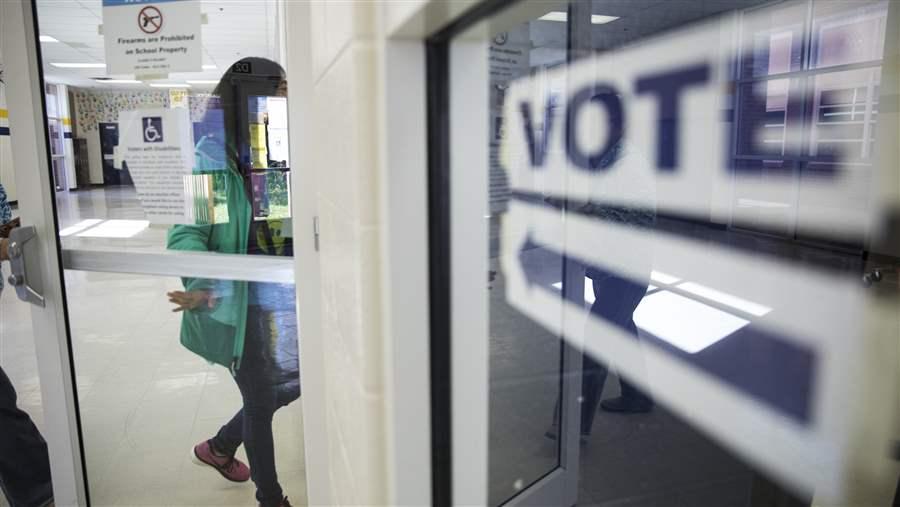
© Samuel Corum/Anadolu Agency/Getty Images
Overview
In every state and the District of Columbia—except North Dakota—individuals who programme to vote in a federal election must get-go register to vote. Still, a sizable share of eligible citizens practise not register. Official statistics vary, just a conservative guess, calculated using information from the U.Due south. Demography Agency's most recent Voting and Registration Supplement, indicates that 21.4 percent were non registered to vote in 2014.one
Registration's importance to the voting process and the large number of individuals who remain unregistered have spurred several major reforms intended to increase voter registration. About notably, the federal government's National Voter Registration Act of 1993 (NVRA) requires that states allow eligible citizens to register to vote when completing other transactions at state motor vehicle and social services agencies, a provision normally known as Motor Voter.ii Since enactment of the law, some states have expanded on this requirement by automating the Motor Voter procedure. Colorado upgraded its Motor Voter process in 2017, and Oregon became the first state to implement automated voter registration in 2016, with at least 6 more planning to implement similar policies in the future.iii Other states offer Same Day Registration, which allows individuals to register and vote on Ballot Day, often right at their polling places.iv
Despite these efforts, piffling is known well-nigh eligible but unregistered U.S. citizens' exposure to opportunities to register, reasons for choosing not to, or attitudes toward the balloter system and civic date, or how many of them are interested in registering in the hereafter. To brainstorm to fill this gap, The Pew Charitable Trusts commissioned a nationally representative survey conducted in March and April 2016 that included a large population of unregistered individuals. This chartbook presents findings from the survey well-nigh the attitudes and experiences of those who said they were not registered to vote in the months preceding the 2016 presidential ballot, including:
- Less than xx per centum of eligible citizens have been offered the gamble to register at a motor vehicle or other government agency.
- The unregistered were more probable to say they do not vote because they dislike politics or believe voting will non make a difference, while people who are registered but vote infrequently say they practice not vote more ofttimes because they are not informed enough almost the candidates or issues.
- At least 13 percent of the unregistered, more often than not those who are younger and more civically engaged, say they could be motivated to register in the time to come.
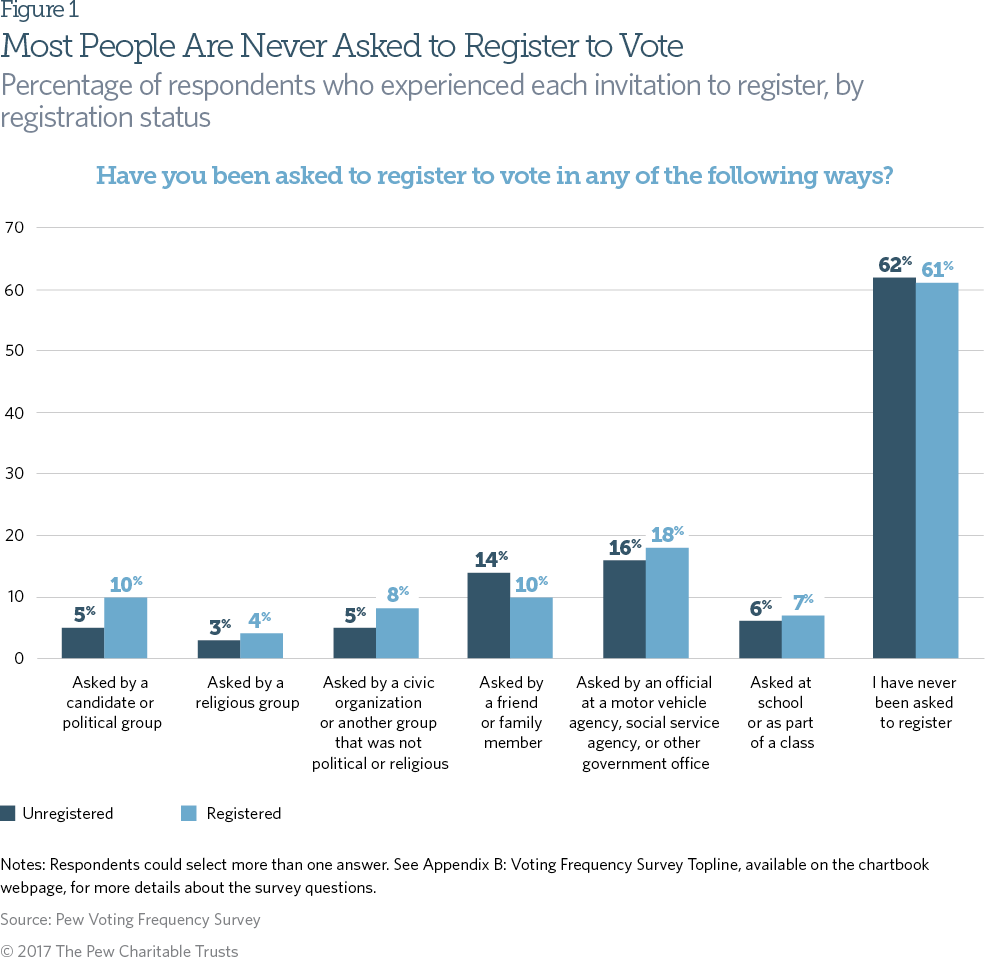
Because the American voting organization requires individuals to annals before they can vote, many political campaigns, nonprofits, religious organizations, and other groups concord voter registration drives. Despite these well-publicized efforts, more than 60 percent of adult citizens have never been asked to register to vote, and the rate was about identical among individuals who are and are not registered.5 Among respondents who had been invited to register, the nigh likely context was by an official at a motor vehicle agency, social service agency, or other government office. However, less than 20 percent of all those surveyed reported such an occurrence, which indicates that the NVRA has not been successful at reaching a large percentage of the population.
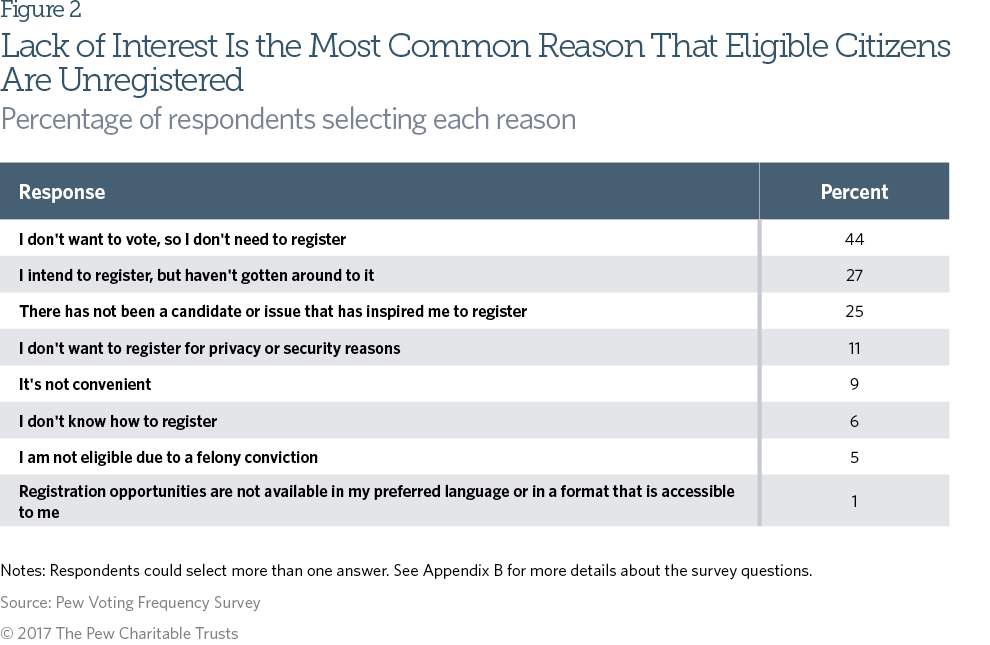
Xl-four percent of eligible unregistered individuals say they do non want to vote. Another 27 percent say they intend to register but haven't done and so yet, and 25 percent say they are unregistered considering they take not been inspired by a candidate or outcome. Eleven pct practise not desire to annals due to privacy or security reasons. The survey was conducted earlier revelations in fall 2016 that hackers had targeted information from country voter registration systems, then the results exercise non reflect the public concern about the security of voter information that developed belatedly in the campaign.half dozen
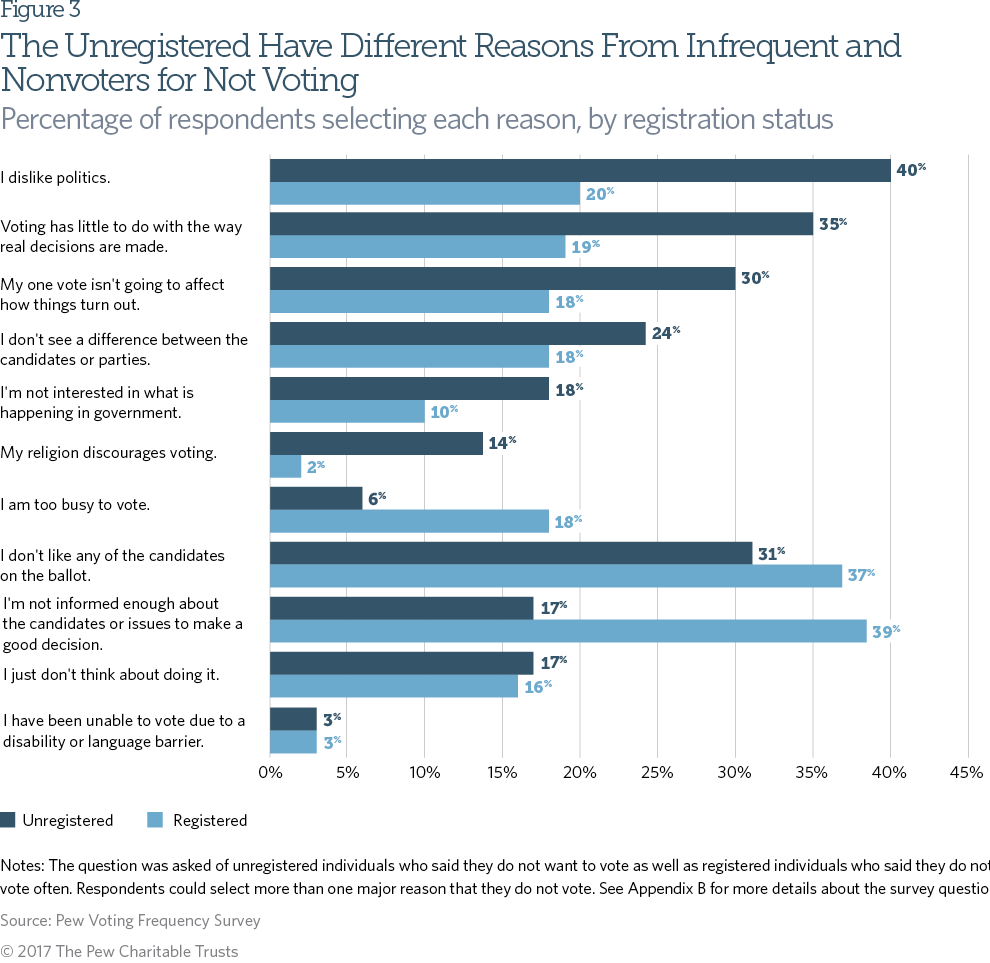
The unregistered are more likely to indicate a broad distaste for the balloter organization than registered individuals, who tend to give election-specific motives for nonvoting, such as disliking the candidates or non knowing enough well-nigh the issues. Forty percent of the unregistered say their aversion to politics is a major reason they don't want to vote, and 35 percent say voting has little to practise with the mode existent decisions are made, compared with 20 and 19 percent of registered simply infrequent voters, respectively.
Previous research has institute that many unregistered students feel they should not vote considering they are insecure nigh their political cognition.7 However, this survey establish that only 17 percent of the unregistered population chose not to vote because they are likewise uninformed nearly the candidates or issues to make good decisions, compared with more than twice that amount—39 percentage—of registered exceptional voters.
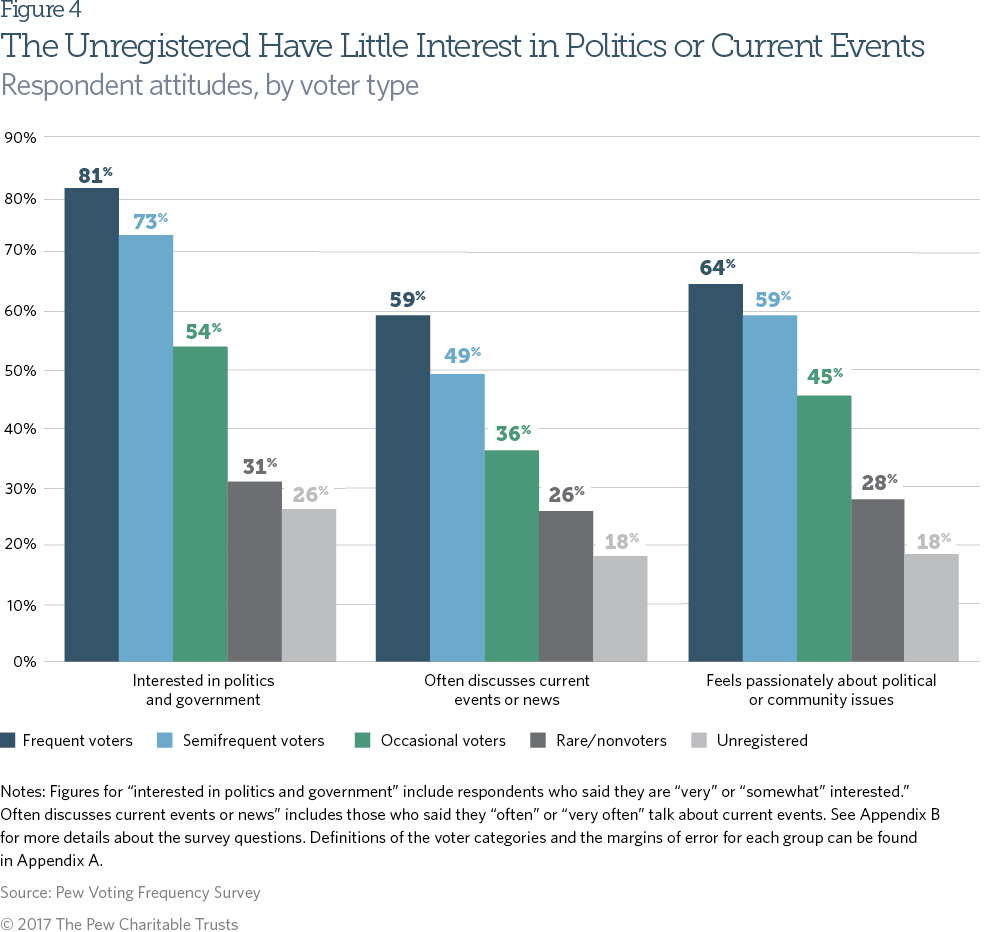
Some people vote in many types of races, while others turn out only for certain elections or are registered but never vote. For example, in 2016, approximately lx percentage of eligible citizens voted in the presidential election, simply in the 2014 congressional races, turnout was less than 40 percent.8 To improve understand how the unregistered population compares with these different groups of voters, the survey asked respondents to think well-nigh the diverse types of elections and evaluate how ofttimes they have voted since they were first eligible.9 Based on measures of people's interest in government, current events, and political bug, unregistered individuals differ very little from those who are registered but rarely or never cast a ballot, while frequent voters are more three times equally likely every bit the unregistered to limited involvement in government.
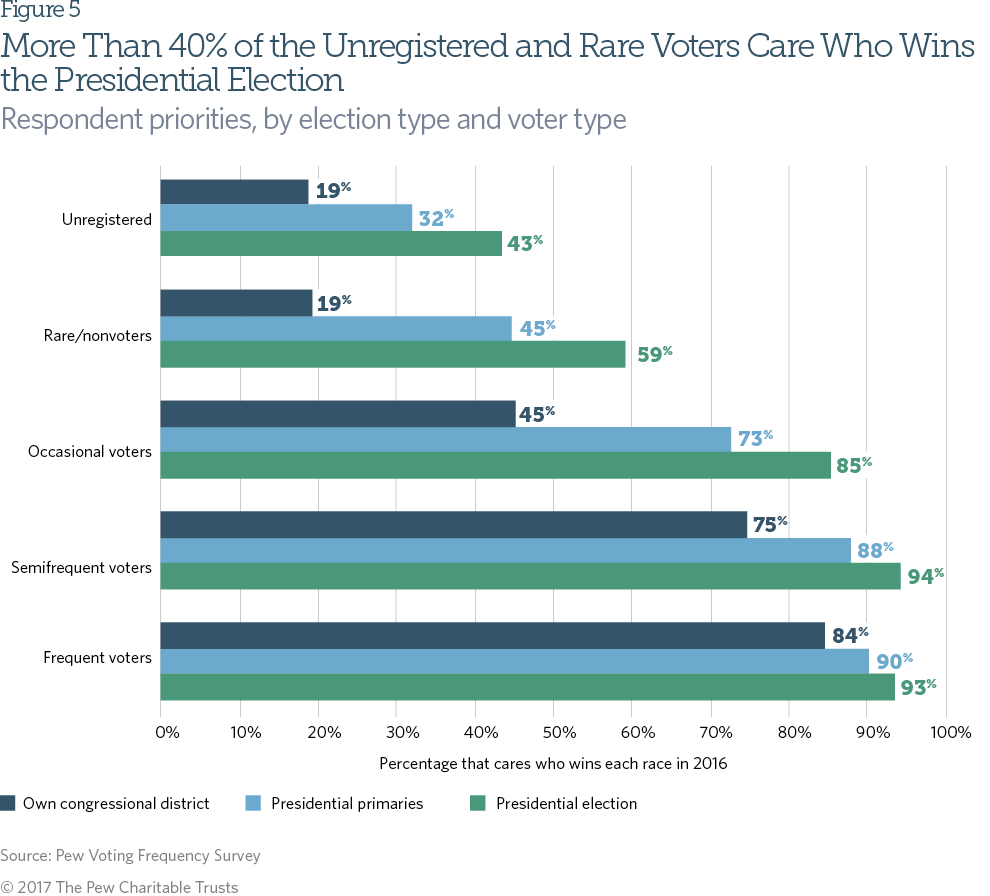
Despite non participating in elections, 43 percent of the unregistered and 59 percent of rare or nonvoters say they care a adept deal who wins the presidential ballot. These groups expressed far less interest in the outcome of congressional races and presidential primaries, while frequent voters care virtually the winner of all three types of elections at very high rates. Although some of the unregistered may intendance who governs, many of these respondents still were not interested in participating in choosing the president: Just 38 percent said they intended to register but had not done and so at the fourth dimension of the survey, and 32 per centum said they did not desire to vote, probably because of their full general belief that voting is asunder from the way real decisions are made and their feeling that 1 vote would not affect the consequence of the election. (See Effigy 3.)
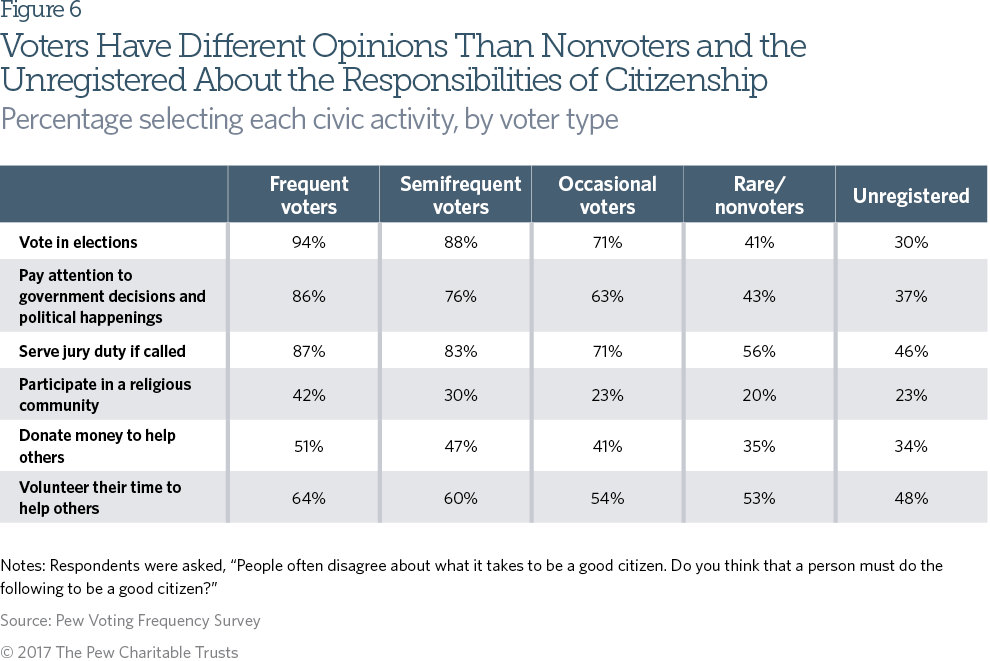
Voters diverge significantly from the unregistered in terms of their views well-nigh the behaviors that are necessary for a person to be considered a good citizen. Jury service was the most commonly selected behavior for good citizens beyond groups at 69 percent of all respondents. However, beyond groups, the priority on jury duty differed widely: Just 46 percent of the unregistered identified this as an essential responsibility of skilful citizenship, compared with 87 percentage of frequent voters. Voters and the unregistered tended to be more like-minded about behaviors such as volunteering time to assistance others. 60-four percent of frequent voters and 48 percent of the unregistered said volunteering is something that a person should do to be a good citizen. Voting in elections and paying attention to politics were the two behaviors about which voters and the unregistered population differed nearly. Frequent voters were more than three times as likely as the unregistered to say voting is something that proficient citizens should practice.
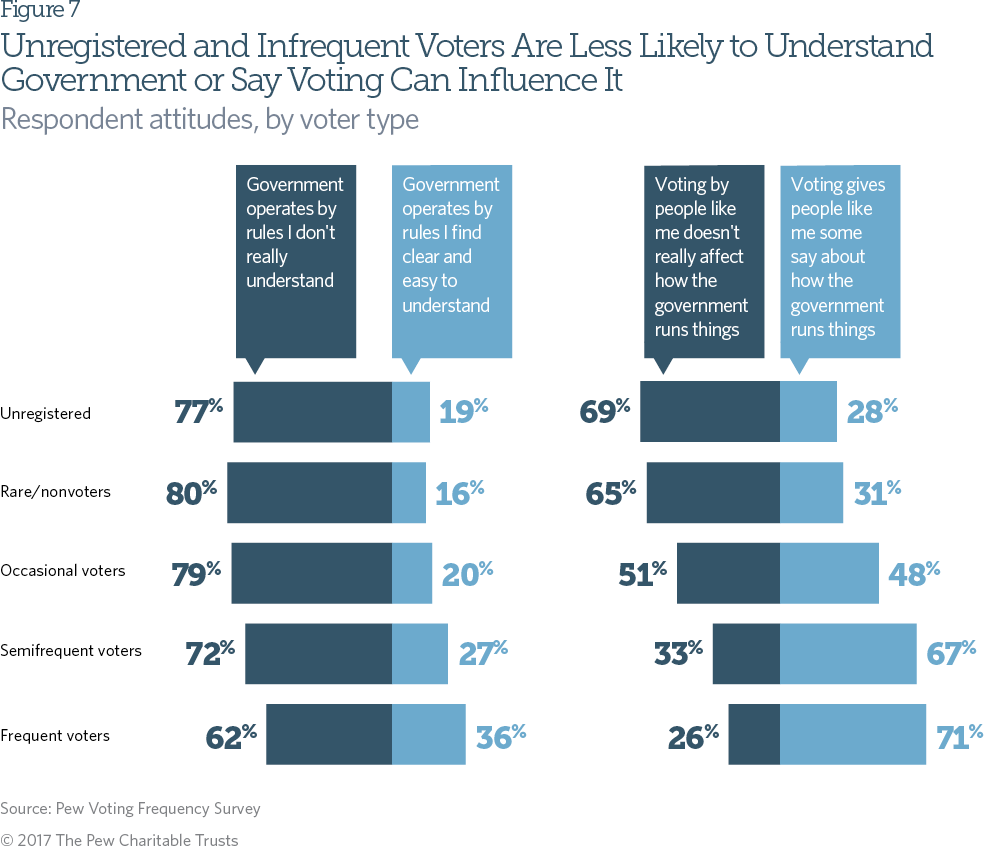
An individual's belief that he or she is qualified to understand and participate in politics is considered a key metric for inferring engagement in the political organisation.10 All groups, except the most frequent voters, reported that the rules of regime are difficult to understand at roughly like— and high—rates. Merely when asked if voting could influence the way the authorities is run, the unregistered and rare or nonvoters both tended to say it does non, which very clearly diverged from more frequent voters, who largely said voting does impact governance.
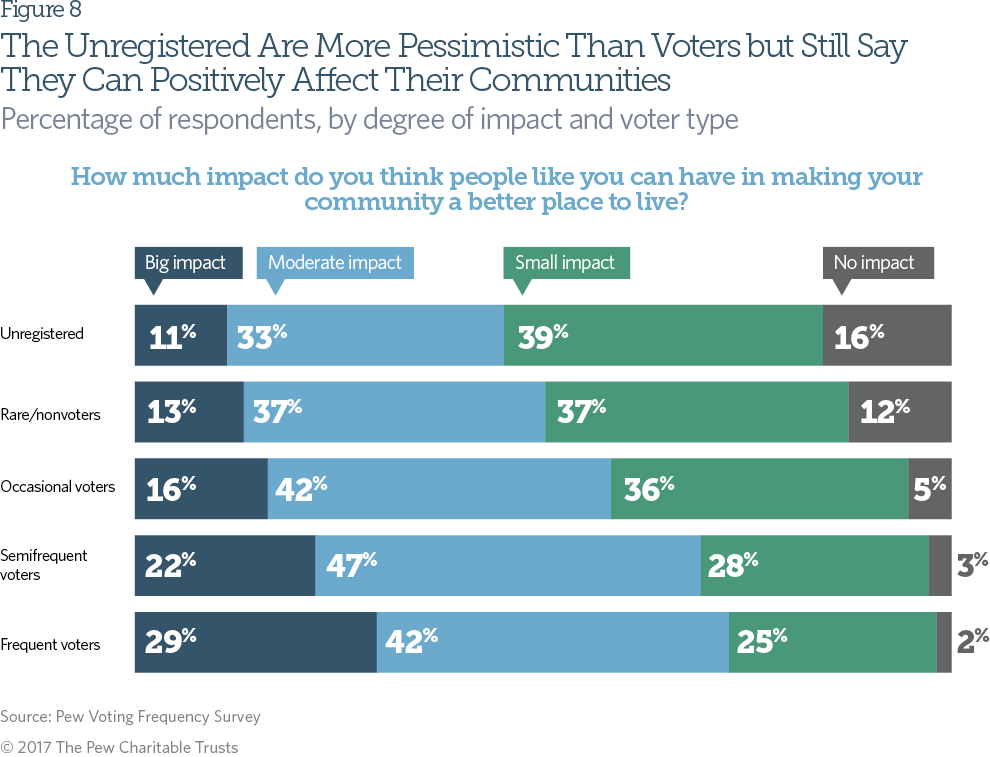
Most people, including more than 80 percent of the unregistered population, said they could have at least a small positive impact on their communities. Occasional, semifrequent, and frequent voters were all most likely to say they could have a moderate effect, while rare and nonvoters were as likely to choose moderate or small. The largest share of unregistered respondents said they could have only a small bear upon.
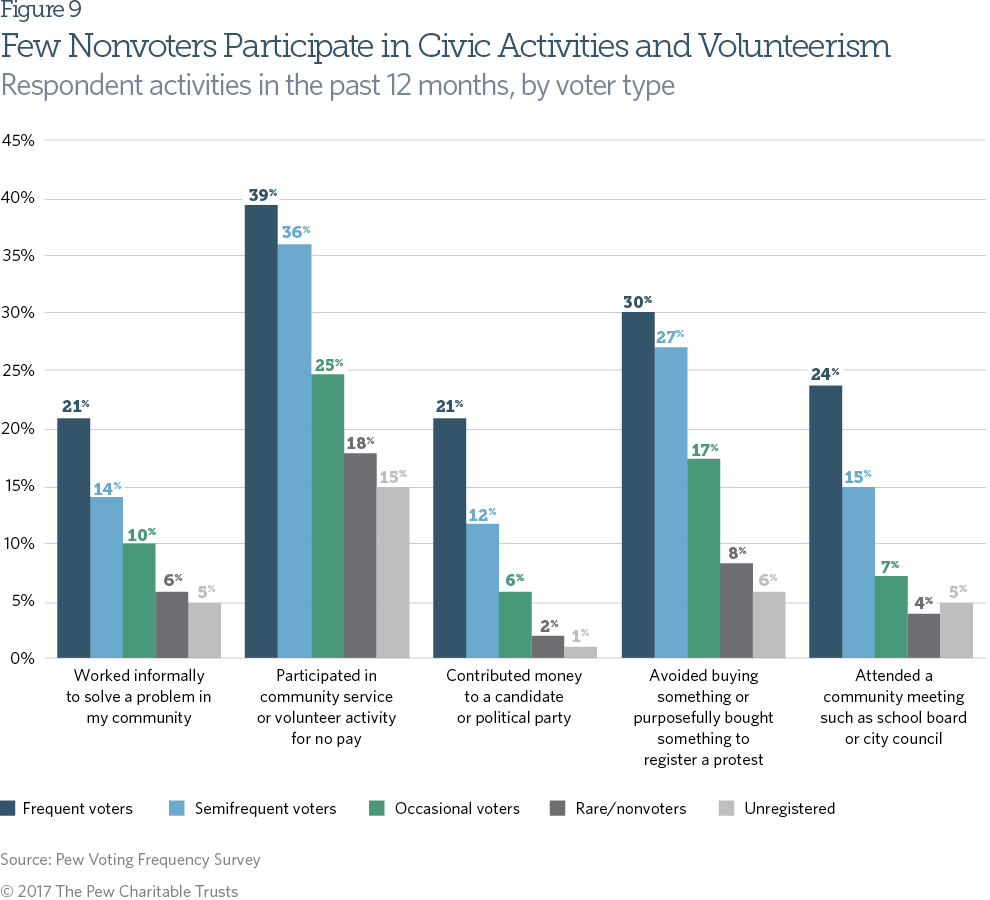
Given that nonvoters and the unregistered have limited conviction in their ability to affect their communities, the fact that they are less probable to engage in civic and volunteer activities than groups who vote more often is not surprising. Across different types of activities, the unregistered and nonvoters participate more often in those that are not political in nature. Simply 1 percentage of the unregistered accept donated money to a political candidate or organization, and only v percent take attended a community coming together. Yet, fifteen percent have done unpaid volunteer piece of work. The civic behaviors of the unregistered population did not differ significantly from those of respondents who rarely or never vote and, in some cases, occasional voters were nearly every bit disengaged.
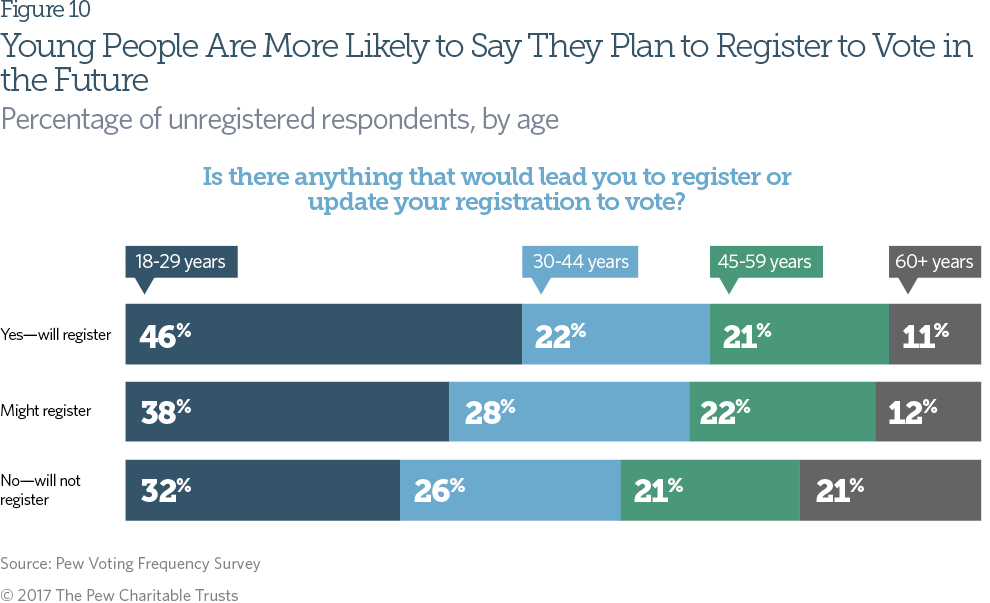
Amongst the unregistered population, responses differed virtually possibly registering to vote in the time to come. Overall, 43 percent of the unregistered said nothing would motivate them to annals, 13 percent said something might, and 44 per centum were undecided. Those who were open to registration tended to be younger: Xl-six percent of those who said they would register were between xviii and 29 years old, compared with 21 pct ages 45 to 59 and merely 11 pct 60 or older.
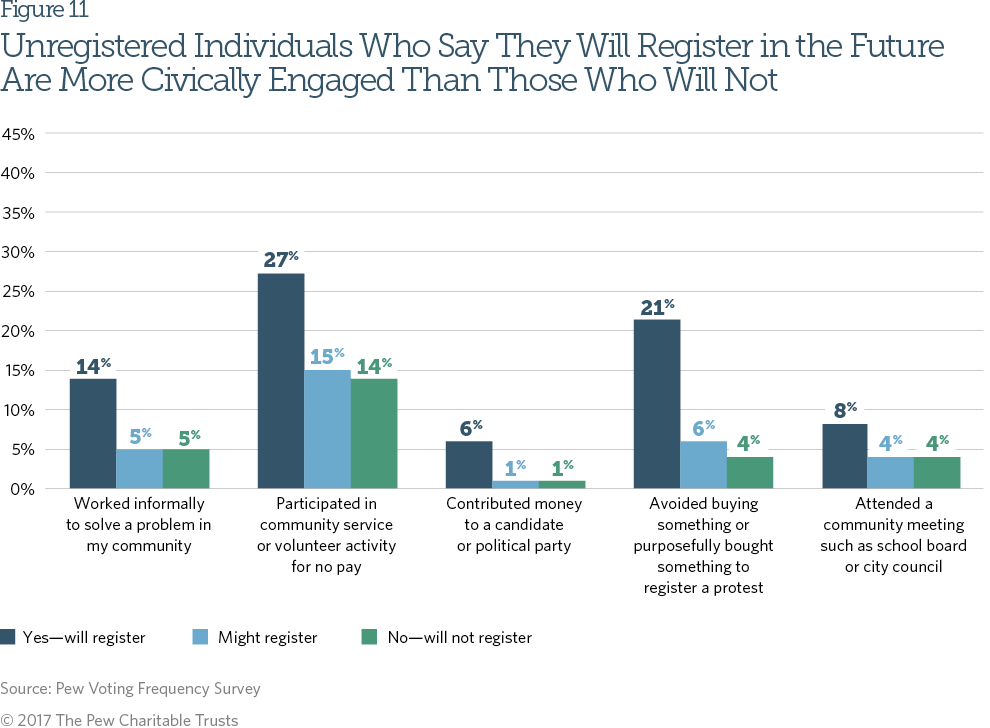
Amidst the unregistered, those who said they would register reported patterns of civic engagement that closely resembled those observed for occasional or semifrequent voters. Fourteen percent of unregistered individuals who said they would register and semifrequent voters had worked informally to solve a trouble in their customs, and 21 and 27 percentage of those groups, respectively, had engaged in economic protestation. Similarly, 27 percent of those who would register had done unpaid volunteer piece of work, vi percentage had contributed money to a candidate, and 8 percent had attended a community meeting, all which closely track the rates among occasional voters (25 percent, 6 percent, and vii percent, respectively. Run into Figure 9.)
Determination
The unregistered differ in many ways from those who vote oft: They are less interested in politics, less engaged in civic activities, and more cynical about their ability to understand and influence government, but they are not appreciably different on these measures from individuals who are registered simply rarely vote. Withal, the unregistered population is not entirely unengaged from borough life; some indicated that they would register, and that group besides reported participating in community or political activities at rates like to occasional and semifrequent voters. Further, more than than 40 per centum of the unregistered cared who would win the presidency in 2016, and some indicated that they could be motivated to annals in the future, though many also feel that the voting procedure does non affect the way governing decisions are fabricated. These findings suggest that opportunities be to engage segments of the unregistered population, including through consistent outreach at motor vehicle agencies as required under the NVRA and public education campaigns designed to highlight the significance of individual voter participation to ballot outcomes and the connection between local policies and problems these citizens care almost, such every bit those for which they volunteer in their communities. Less than twenty percentage of this grouping has been asked to register by a land agency, and a substantial increase in that figure could help to improve registration rates and electoral participation amid these disconnected citizens.
Methodology
The Voting Frequency Survey was conducted online in English and Spanish from March 25 to April 19, 2016, by the GfK Group on behalf of The Pew Charitable Trusts. The total sample size was 3,763 U.South. citizens 18 years or older. GfK sampled households from its KnowledgePanel, a probability-based, nationally representative web panel. The margin of error, calculated with the design result, at the 95 percentage level of confidence for the total sample is plus or minus i.9 pct points. A full methodology, including margins of error for key subgroups, is given in Appendix A: Voting Frequency Survey Methodology, bachelor on the chartbook webpage. The survey questions and frequencies are available in Appendix B: Voting Frequency Survey Topline.
Endnotes
- The Census Bureau calculated that 35.4 pct of eligible citizens were non registered to vote in 2014, as reported in "Who Votes? Congressional Elections and the American Electorate: 1978-2014," July 16, 2015, https://www.census.gov/library/publications/2015/demo/p20-577.html. However, researchers concur that this calculation artificially inflates the per centum of the population that is unregistered because information technology includes those who were not asked or did not answer the registration question in the Voting and Registration Supplement as being unregistered. More than information on the method for adjusting the registration rate can exist found in The Pew Charitable Trusts, Elections Performance Index: Methodology (August 2016), http://world wide web.pewtrusts.org/~/media/avails/2016/08/epi_methodology.pdf.
- The National Voter Registration Human action applies to 44 states and the Commune of Columbia. Idaho, Minnesota, New Hampshire, North Dakota, Wisconsin, and Wyoming are exempt considering at the time the constabulary was implemented, they offered Election Day registration or had no registration requirements.
- National Conference of State Legislatures, "Automatic Voter Registration," March 8, 2017, http://www.ncsl.org/research/elections-and-campaigns/automatic-voter-registration.aspx.
- National Conference of State Legislatures, "Same Twenty-four hour period Voter Registration," January. 11, 2017, http://www.ncsl.org/enquiry/elections-and-campaigns/same-day-registration.aspx.
- Differences are within the margins of mistake, which are 3.62 percentage points for the subgroup of unregistered respondents and 2.21 percentage points for registered voters.
- Eric Geller and Darren Samuelsohn, "More than Than 20 States Have Faced Major Election Hacking Attempts, DHS Says," Politico, Oct. iii, 2016, http://www.pol.com/story/2016/09/states-major-ballot-hacking-228978.
- D.J. Neri, Jess Leifer, and Anthony Barrows, "Graduating Students into Voters" (April 2016), http://www.aascu.org/programs/ADP/StudentsintoVoters.pdf.
- Michael P. McDonald, United States Elections Projection,"Voter Turnout," accessed Feb. half dozen, 2017, http://www.electproject.org/home/voter-turnout/voter-turnout-data.
- The question asked: "There are many types of elections such as federal elections for president and members of Congress, master elections where voters choose party nominees, local elections for city council and school lath, and special elections when vacancies arise in between scheduled elections. Which best describes how often yous vote, since y'all became eligible? Every election without exception, Virtually every election – may have missed one or two, Some elections, Rarely, Don't vote in elections." The four frequencies of voting reflect respondents' answers to the question of how ofttimes they vote. Individuals who answered "Every election without exception" are defined as frequent voters, "Virtually every election – may have missed one or two" are semifrequent voters, "Some elections" are categorized equally occasional voters, and the answers "Rarely" and "Don't vote in elections" were combined into a group chosen rare or nonvoters, both due to sample size and because these two groups were nearly identical on central measures.
- Richard G. Niemi, Stephen C. Craig, and Franco Mattei, "Measuring Internal Political Efficacy in the 1988 National Election Study," The American Political Science Review 85, no. 4 (1991): 1407–13, doi:ten.2307/1963953.
Additional Resource
More than FROM PEW
Source: https://www.pewtrusts.org/en/research-and-analysis/issue-briefs/2017/06/why-are-millions-of-citizens-not-registered-to-vote
0 Response to "what percentage of us population is eligible to vote"
Post a Comment