Approximately 52% of Hcc Patients Who Go Into Remission Will Contract Hcc Again
, by NCI Staff
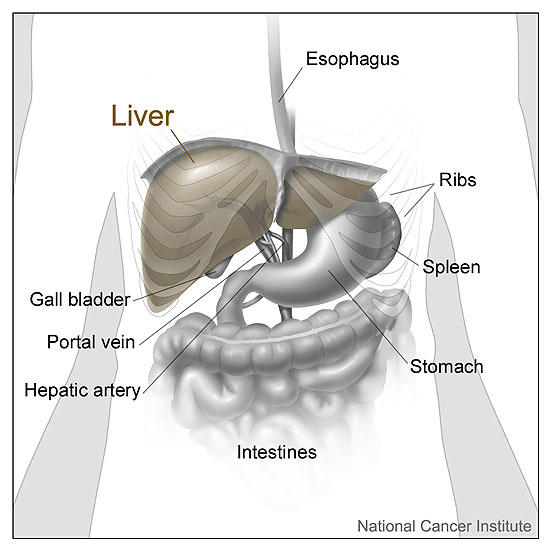
FDA has approved the immunotherapy drug atezolizumab, used with bevacizumab, to treat some patients with advanced liver cancer.
Credit: National Cancer Institute
For the kickoff time in nearly xiii years, in that location is a new treatment bachelor that appears to be better than a standard therapy for people with a type of liver cancer chosen hepatocellular carcinoma (HCC). On May 29, the Nutrient and Drug Assistants (FDA) approved atezolizumab (Tecentriq) and bevacizumab (Avastin) as an initial treatment for people with liver cancer that has spread or that can't be treated with surgery.
In the study that led to the approving, chosen IMbrave150, liver cancer patients treated with atezolizumab and bevacizumab lived substantially longer than those treated with sorafenib (Nexavar). They also lived longer without their cancer getting worse. The study findings were published May fourteen in the New England Journal of Medicine.
"This is a huge advance for patients," said i of the written report scientists, Richard Finn, Grand.D., of the University of California, Los Angeles. "This has been something that doctors who treat these patients have wanted for a long time, and this is a significant comeback."
Atezolizumab is an allowed checkpoint inhibitor, a type of treatment that helps the immune organisation seek out and destroy cancer. Bevacizumab is a targeted therapy that starves tumors by preventing new blood vessels from growing.
Sorafenib is some other targeted therapy that blocks the growth of claret vessels and cancer cells. In 2007, sorafenib became the start drug approved by the FDA to treat some patients with HCC.
Until at present, the only treatments for HCC that have been approved since 2007 are no more than effective than sorafenib, said Tim Greten, Thou.D., deputy chief of the Thoracic and GI Malignancies Branch of NCI'south Heart for Cancer Inquiry.
And non only is the atezolizumab–bevacizumab combination more effective, it also led to "strikingly meliorate patient-reported outcomes," such as physical abilities, Robin Kelley, M.D., of the UCSF Helen Diller Family unit Comprehensive Cancer Center, wrote in an editorial.
The combination regimen will likely replace sorafenib as the standard initial handling for some people with advanced HCC, Dr. Greten said.
Adding on to Immune Checkpoint Inhibitors
Liver cancer is often diagnosed when it has already spread beyond the liver or is intertwined with many blood vessels, preventing information technology from being treated with surgery.
For people with liver cancer that can't be treated with surgery (is inoperable), sorafenib and lenvatinib (Lenvima)—another drug that blocks claret vessel growth—are the only options for initial handling.
A scattering of clinical studies have tested immune checkpoint inhibitors equally initial treatments for liver cancer only found that they didn't work well on their own. With some more digging, scientists later found that loftier levels of a poly peptide chosen VEGF may prevent immune checkpoint inhibitors from working.
VEGF stimulates the growth of new claret vessels and also changes the number and blazon of immune system cells in and around tumors, Dr. Finn explained.
Because bevacizumab blocks VEGF, researchers from Genentech and several different medical centers tested atezolizumab with bevacizumab in a small study of people with liver cancer. In 2019, they reported that the combination was more constructive than atezolizumab solitary and had tolerable side effects. The IMbrave150 trial is a follow-up to that earlier study.
Findings from the IMbrave150 Trial
The IMbrave150 trial, sponsored by F. Hoffman–La Roche/Genentech, involved more than 500 people with HCC. All participants had inoperable tumors and none had received whole-body (systemic) cancer treatment before.
Participants were randomly assigned to receive sorafenib or atezolizumab plus bevacizumab until the treatment stopped working or until the side effects became also harsh.
By all measures, the combination treatment worked ameliorate than sorafenib. More people who were treated with the combination than with sorafenib were however alive after 1 year: 67% in the combination grouping and 55% in the sorafenib group.
The length of fourth dimension that one-half of the patients in a handling group are still alive, chosen median overall survival, is a cardinal measure of how well a treatment works. The median overall survival was 13 months in the sorafenib group and longer in the combination group.
The exact duration is nevertheless existence determined for atezolizumab plus bevacizumab because most of the patients in that group are still alive, Dr. Greten noted.
Patients who received the combination handling also lived three months longer without their cancer getting worse or dying (7 months versus 4 months for sorafenib).
The treatment worked—meaning it shrank tumors—for more patients who received the combination than sorafenib (27% versus 12%). That "is the highest reported [response] rate in a stage 3 trial for hepatocellular carcinoma to date," Dr. Kelley noted.
In addition, far more patients in the combination group had a complete response, meaning all signs of cancer disappeared completely (vi% versus 0% in the sorafenib group).
Although complete responses are noteworthy, "the more than important point is how long patients actually benefit from the handling," Dr. Greten said. The treatment worked for longer than 6 months in 88% of people in the combination grouping and in 59% of those in the sorafenib group.
Patients in both treatment groups reported that their quality of life got worse during the study catamenia. But people treated with the atezolizumab‒bevacizumab combination reported that their quality of life was preserved for considerably longer, about 7 months more than those treated with sorafenib.
"The goal with incurable cancers is to extend survival and maintain quality of life," Dr. Finn stressed. In the studies that led to sorafenib's blessing, it didn't meliorate quality of life over a placebo treatment, he added.
Safe of Atezolizumab Plus Bevacizumab
Many patients experienced side furnishings from the combination handling. But overall, patients appeared to tolerate both drugs, Dr. Greten said.
There were like rates of side furnishings and deaths due to side effects in the two groups. But more patients in the combination grouping had whatsoever serious side effects (38% versus 31%).
Fewer patients in the combination group paused or changed the dose of the treatments considering of side effects (50% versus 61% in the sorafenib group). And although more patients in the combination group stopped taking 1 of the drugs (sixteen% versus 10%), only 7% stopped taking both drugs because of side effects.
Bevacizumab can cause bleeding because of its effects on blood vessels, Dr. Greten explained. Liver cancer can also cause changes that heighten the run a risk of bleeding, such every bit depression numbers of platelets, he added.
"There were a few more bleeding events in the atezolizumab‒bevacizumab arm, but still, as a percentage, it's very low," Dr. Finn said. Six percent of patients in both groups had serious bleeding events related to bevacizumab treatment.
"Information technology will be important to identify the right patient population" for the combination treatment, Dr. Greten said. Patients may take to go routine tests to cheque for bleeding chance factors before taking the treatment, he suggested.
"Culling therapies should be considered for patients at high risk for bleeding," Dr. Kelley wrote.
More Combination Treatments Likely to Come
Many ongoing studies of HCC are testing combinations of an immune checkpoint inhibitor and a drug that targets blood vessels, such as pembrolizumab (Keytruda) and lenvatinib, Dr. Finn said. Other studies are testing combinations of immune checkpoint inhibitors, Dr. Kelley noted.
"Nosotros've made a huge stride [with this study]," Dr. Finn said. But he and his colleagues are already thinking about how to continue to meliorate liver cancer treatment. "The question now is, what practice nosotros add together on to bevacizumab and atezolizumab?"
Another future goal is to find biological markers (biomarkers), like the level of a blood protein, that doctors can employ to figure out which patients are most likely to reply to immune checkpoint inhibitors that are function of a combination treatment. In general, immune checkpoint inhibitors are just effective for a fraction of patients with liver cancer.
"Information technology would be helpful if you could actually place the patients" who are likely to do good from the treatment, Dr. Greten said. One of the ongoing goals of NCI'south Liver Cancer Program, of which Dr. Greten is the codirector, is identifying biomarkers for immunotherapy.
Source: https://www.cancer.gov/news-events/cancer-currents-blog/2020/fda-atezolizumab-bevacizumab-liver-cancer
0 Response to "Approximately 52% of Hcc Patients Who Go Into Remission Will Contract Hcc Again"
Post a Comment